Saturday, October 17, 2020

Observing Note from 9/27 regarding the 8 inch f/6 newt

I forgot to jot down my thoughts on observing briefly back on 9/27/20 with my 8 inch f/6 newt.  I started my evening by setting up the 8 inch f/6 newt, collimating carefully, and letting things cool down for 2 hours.  I decided to throw a hail mary and use the 3mm Delite eyepiece resulting in a 400x view of Mars.  For maybe 5-10 minutes, the view was contrasty and well-defined as the seeing seemed to be above average. From what I remember, Mars was still in the east and I was very surprised at the wealth of surface detail.   (Usually the seeing to the east is below average to awful.)

I also scanned the moon and I was able to see the kind of detail that I usually see from the C11 through the barlow and QHY290m.  

But after awhile, the image started shimmering and shaking and the magnification was clearly too much for the seeing conditions.  

Part of the reason for setting up the 8" newt was Venus.  My excitement was based on a theoretical notion that since the 8" f/6 was a two mirror system, there would be much greater UV throughput.  The C11 has two mirrors plus a corrector plate that obviously has anti-reflective coatings on it.   Also, the corrector plate itself could be a bad transmitter of UV light.   

I collected some RGB on Mars and it was pretty disappointing.   The seeing was below average and surface detail was not well defined at all.  Usually with the C11, I can see a few scant moments of decent detail in below average conditions.  But not with the 8 inch.   This runs sorta counter to a lot of received wisdom about aperture, seeing and the size of your scope.


This is a screen shot of the best moments of a single video from the C11 on 9/30/20 on the left and 8 inch f/6 newt 9/27/20 on the right.  In fact, I'm even cheating a bit on the right by shooting through the Baader 685nm IR passthrough filter.  The right image should be a lot more contrasty.  It's also worth mentioning that I had to lower the FPS to deal with the loss of brightness through the smaller instrument.  So my chances of getting a few "lucky" frames were much lower in the 8 inch.   Much less barlow power would have been useful to keep the FPS high, but that would have meant something like a specialty 1.3x barlow.

Perhaps no fair conclusions can be drawn from the image above and the evening in general.  It is quite possible that the C11 would have just produced a larger version of the poorly detailed image on the right.    But what is certain is that the theoretical maximum amount of detail will always come from the larger scope so there's not very many good reasons to use the 8" over the C11.

Later, I was able to test my theory about UV transmittance.  The seeing continued to be poor into the early morning hours.   The video through the Baader UV filter, QHY290m, and the Siebert barlow was also poor.   Not a definitive test by any means, but it didn't look like I was getting much UV at all through the 8" f/6.   To be fair when seeing is below average, it's hard to see any UV details on Venus with the UV filter.  I was expecting some obvious difference but none appeared.  It's quite possible that the coatings on the 8" mirror don't transmit UV signal well; or that there is enough deterioration of the coatings that the UV transmittance has been compromised.
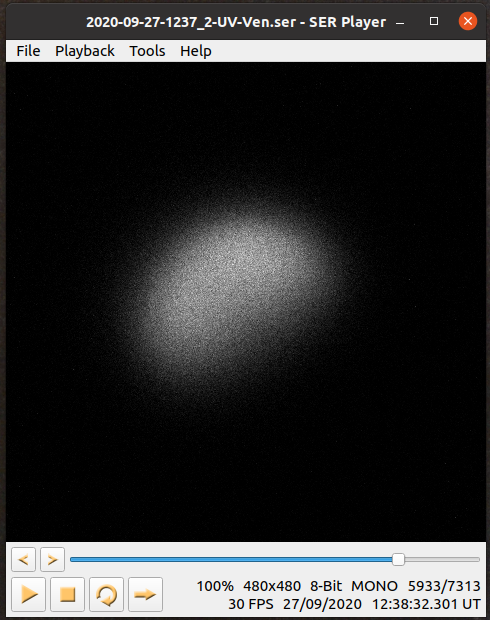


This is one of the better frames of early morning Venus on 9/28/20.  There is some north and south brightness and hints of larger, darker structure of the equatorial areas.   But most frames were just misshapen blobs of uniform brightness.

(Later:  I was looking at more video from the 8 inch and there is a consistent "fuzziness" (or scatter) in the images which make me wonder if there is an optical defect like a turned edge.   It doesn't jive with the 400x views I had early in the evening, but sometimes very good seeing fixes a lot of problems.   Hm...)


(Later, later:  I think there's a good chance I FORGOT to place the UV/IR filter in the camera for the color data.)  πŸ‘ΎπŸ”₯πŸ˜“

Wednesday, October 14, 2020

Methane Notes on Saturn and Jupiter

 Just wanted to write the settings and config down for future reference.


With the C11, 2x barlow, the QHY 462C, SATURN capture settings in FireCapture are USB traffic = 3, Gain = 417, Exposure = 248.535067566729.

(Looking at the Saturn video (2020-09-24-0516_1.avi), it's possible I did not have the barlow in place.)

On JUPITER with same gear as above, I had one short video with the same exact exposure and gain settings.   Then I also had a run with Gain = 546 and Exposure = 315.876081949843.  Oddly, this second capture (which was the first one where I tried Methane - 2020-09-24-0628_9.avi) is dimmer than the first video mentioned (2020-09-24-0501_1.avi).  

Hm...  it's possible I tried using the Siebert UV barlow with the 2020-09-24-0630_4.avi file. 

The cleanest Jupiter video is the 2020-09-24-0501_1.avi which was the last methane video I shot that evening. 

It looks like I'm going to have to try just doing this all over and take careful notes on which barlow I'm using on which camera.

My guess is that the best combo is with the TV 2x barlow since the cleanest video show Jupiter as 20-30% smaller than others.  (The Seibert barlow is 2.5x).

I do remember that the QHY290m camera was really bad at methane as I had to push the exposure to 500+ ms with really high gain settings.   Based on QE graphs, it looks like the 290m only picks up about 40% of relative response at 900nm vs 80% from the 462C.

Tuesday, October 13, 2020

Seeing just went to the crapper

After showing H a rather average Mars opposition view through the C11, I setup the scope and gear to resume my imaging campaign.  This time, I'm doing the full meal deal with the QHY290m, filterwheel, 2x barlow (working closer to 3x), and the ZWO ADC.  As I start focusing, I notice that Mars is moving around a lot -- both the wavy-gravy and the fast shimmering are abundant.  There are even moments of complete smear out.   We went from average shimmering to smear out in the course of 10 minutes.   I thought there must be something pushing heat around the scope or something...

Then I look up and notice M45, Capella, and even all of Cassiopeia are flickering and shimmering above.   

The air seems suddenly a few degrees colder and I can feel my lips drying up.  Barring the arrival of a vampire in the vicinity, I think we just got a sustained flow of air coming over the peaks and straight into Doney Park.  

As I write this, it's about 10:30 and both CSC and Astrospheric forecast improvement around 11 pm.   If this shimmering ceases, then yeah, we got some imaging to do.   If it doesn't, I'll be collecting more "bad data" for no apparent reason.  :/

Later:  Seeing was okay to above average from 11:15 to 12:45-ish.   Got a set of data.  Then took a break, tried to resume at 2 am.  At around 2:30, it crapped out again and stayed pretty awful until I gave up at 3-ish.  The sky didn't look particularly bad.   But I noticed around 2:30 am a cold breeze from the NW started up about the same time the seeing went to the crapper... again.


The "full meal deal".


Saturday, October 10, 2020

Some more comet shots from the past

I thought I posted these images when I started this blog...

 
This is an annotated and slightly cropped shot of Comet Lemmon (C/2012 F6 Lemmon) from 4/27/2013.  Looks like I shot it with at 100mm f/4 with a long gone Canon 5D mk II. 4 seconds at ISO 1600.  Approx. 4:37 am.


Tighter cropped area.


Based on the metadata, this was taken on 5/8/2013 at 4:03 am.  Shot with the Canon 5D mk II, 200mm F/2.8 for 10 seconds at ISO 6400.  Looking at the two focal lengths of the above shots, I believe this was the Canon 70-200mm F/2.8 lens that I owned for a few years.  It's unfortunate that I didn't attempt to take these shots with an equatorial mount and small telescope.


Apparently, this parasite-infested image shows that I did attempt a shot with a mount.  The metadata lists this as 303 second shot with a 140mm lens (again I think this is the 70-200mm f/2.8) at F/3.5.  ISO 1600.   And shot with the Canon XT (350D).   5/10/13 at 6:10 am thus the gradient from sunrise.  And of course, I'm assuming this is C2/2012 F6 Lemmon.  (Later:  I'm looking at this in Stellarium and the time must be closer to 4:10 am as the sky would be washed out in a 5 min exposure at 5 am and later.)


This is obviously not C2/2012 F6 Lemmon.  This is a common shot of Panstarrs (C/2011 L4).  Taken at the parking lot of Snowbowl on 3/12/2013.  There were easily about a dozen photographers shooting this at the same time.  Metadata says it was taken with a Canon 5D mk II, ISO 800, 2 second exposure.  The listed lens is 50mm, but I shot it through the long-gone Sky-Watcher 66mm F/6 with the .8 focal reducer.  The listed time is 7:32 pm.


Tuesday, October 6, 2020

Not my usual post

Okay, so I'm looking for Star Trek clips on Youtube because I was considering shooting the Lobster Claw Nebula which resembles the Romulan ship in the first installment of the recent reboot.  I'm trying to avoid political ads since they are all just toxic on a popsicle stick.  So I just clicked though the ad that appeared briefly before the Star Trek video.

Then this political ad appeared in the upper right corner:


When you have a picture, then text next to the picture, one usually assumes the text applies to the image.   It's really basic to layout design, so basic that I don't think you need to even explain it.   For example (I know, I know I'm being Mr. Obvious), if I posted my picture and I wrote, "dummy" next to it, you would completely understand the message.   Well, this appears to be from the Biden campaign.  But I think it's actually a pro-Trump ad attacking Biden. 

>sigh<  

Now where's that damn clip I'm looking for?


Sunday, October 4, 2020

Excellent Seeing ???

I wasn't planning on going out last night, but when I glanced at the seeing forecasts, Clear Sky Chart (I keep saying Clear Sky Clock), predicted excellent seeing from 1-5 am.  Astrospheric also predicted excellent seeing from 2 am onward.  I was doubtful because I've went out under these supposed "excellent" conditions only to discover average seeing with shorter bouts (10 sec to 2 min) of decent to above average seeing.   I set up and took a little Saturn footage relatively early, then waited for Mars and the moon to get to a decent height.

When I checked again around 10 pm, the "excellent" seeing was pushed back to 4 am on CSC but Astrospheric remained the same.  I've also seen this scenario where the excellent seeing gets pushed back constantly until it doesn't start until 7 am (or later).   But having been up once during these delayed excellent forecasts, I've discovered that any excellent seeing that happens after sunrise gets destroyed by the sun which creates all kinds of turbulence for at least an hour.

I decided to set up the QHY462C camera and I tried my two different barlows and I wish I had taken better notes on which barlow I was using at what times.  I tried some A/B comparisons and I think for Mars, the Televue had the sharper view.  

I did some 11 x 2 min runs on Mars between 11 and 4:30-ish.  Prior to 4 am, it was okay but nothing special.  In fact, I was in that situation where I'd have moments of relative stillness in the image, but there wasn't much detail on the surface.  I also began to worry that the 462C was just inferior compared with the 290m with filters.  It just seemed like I was seeing finer detail with the 290m.

I finished a run around 3:30 am and I began to think about wrapping up since I wasn't seeing anything better than the usual okay footage.  But I took a short break, then came out to very still conditions...

(Try "full screen" after starting the video.)

I took this footage a little after 4 am.  I had to stand back to avoid weird lines I sometimes get from taking video so close to the laptop screen.  The footage isn't completely still, there is some mild high-frequency shaking and a little bit of "wavy gravy" but overall, this is MUCH better than what I experience under typical "excellent" conditions.   

So, this is it.  The best sustained seeing conditions I've experienced in maybe 300 nights.  I wish I had had the big dob setup.   It would have been phenomenal.

These conditions are pretty much what you get about 50% of the time in Florida.  In Florida, this would be called "good" to "very good".   Excellent seeing in Florida goes up a notch and that image would be dead still for 5-30 seconds if all your equipment is thermally stabilized.

After doing an 11 x 2 min run.  I took some footage of Uranus and it seemed like conditions worsened a bit.  Then I swung over to Venus and tried using the 462C with the Baader U-Venus filter.   It was pretty awful as the 462 is not very sensitive in ultraviolet.   Switched to the 290m (should have done this sooner) and got some okay Venus footage.   Earlier I collected at least some lunar footage but I don't remember when.  :/

I feel like I need a good old spiral notebook when I'm out shooting.

[Later:  I think I figured out how to properly read the seeing forecasts: 1) First, they are not going to be accurate 3 days out.  Too many variables around a mountain.  2) If Clear Sky Chart says excellent 12 hours before AND Astrospheric predicts excellent skies for a LARGE swath of land (including all of San Francisco Peaks), then it will probably be at least very good.  The dark blue area of excellence needs to extend for at least 30 miles in all directions.  Just as a point of reference, both Meteoblue and GoodtoStargaze completely dropped the ball on the 4 am excellent seeing. ]


Thursday, October 1, 2020

So the results of the seeing forecasts are...

 Here we are at 11:35 pm on Oct 1 (Thursday night):


Clear Sky Clock seems to say that between 1 and 3, then 7 am onward it's going to be excellent.


Astrospheric predicts above average from now to sunrise.


Someone at Meteoblue finally updated their seeing numbers.  Which seem to suggest average seeing.


And the Goodtostargaze folks seem to generally corroborate Meteoblue.

I just spent about 45 minutes outside examining Mars and it's definitely mediocre to average.  So at least right now, Clear Sky Clock and Astrospheric are just plain wrong.   I think the winner here is Goodtostargaze.

I'll update things again around 2 am, but from what I saw a little while ago, it's not looking great.

(Update:  So, I was out until 3:30 am and I saw some moments of improvement but generally, it was average.   From 2:00 to 3:00 am, I had brief moments of (10 seconds to 2 minutes?) of excellent seeing interspersed with average seeing, but I had a hard time tracking focus.   My red focus would sometimes "wander" far away from what it should be and I thought my focus was slipping, but then 5 minutes later, it would be exactly where it should be.  Focus shift has been a problem - primarily because the Zhumell focuser (probably made by GSO) does slip when pointing near vertical.  I've tightened allen bolts but sometimes, it just slips (meaning it won't move "up" though I'm turning the focus knobs).  A 3 inch FT would not have this problem -- especially with the puny 3 lb load I have on it.  I keep thinking an electric focus would help (it would), but I worry about creating a "chain of cheapness" which will equal more disappointment.)